Blog
Blog
Why Smart Leaders Build Diversity in Teams: The Science of Collective Intelligence
How inclusive leadership experts leverage team diversity to drive exceptional performance and innovation
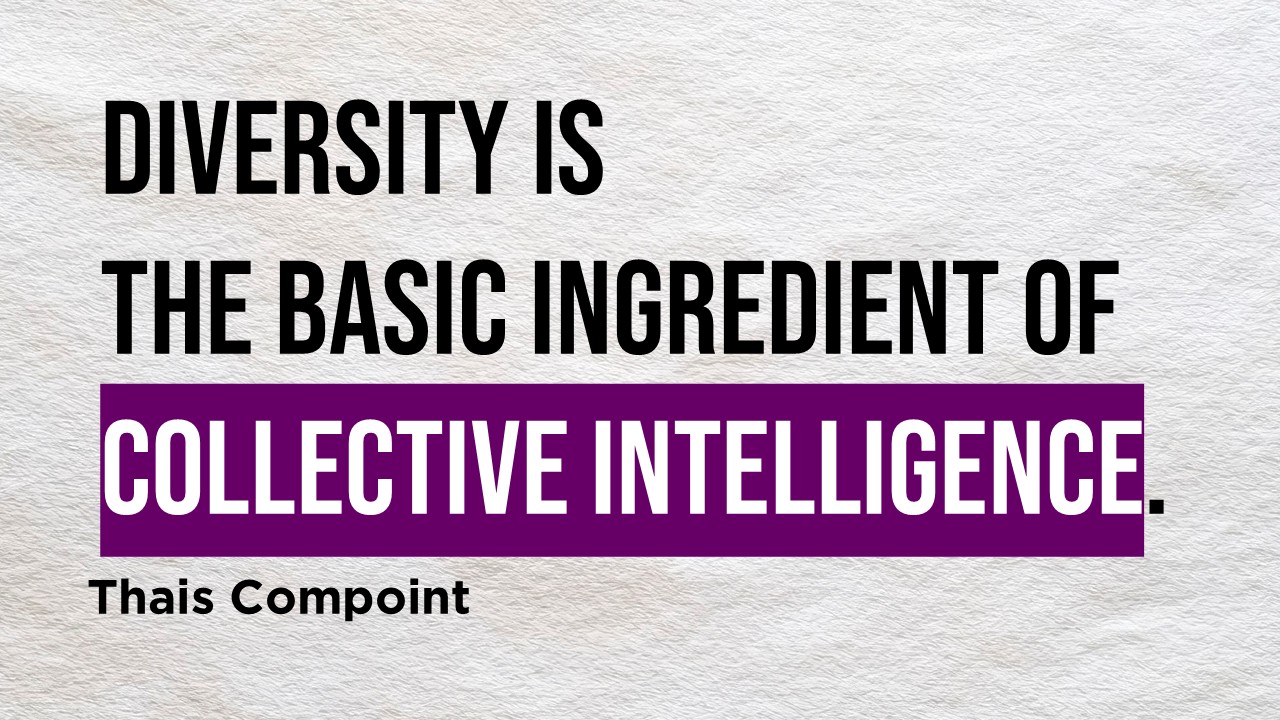
A senior Belgium leader in the FMCG industry once shared something profound with me: “You know Thais, I never hire for the role, and I think that’s the reason why my teams are so outstanding. I hire for the team.” Her approach wasn’t just intuitive—it was scientifically sound. She understood that diversity isn’t merely the icing on the cake; it’s the basic ingredient of collective intelligence.
This insight, brilliantly articulated by Matthew Syed in his bestselling book Rebel Ideas, forms the foundation of strategic inclusive leadership. As inclusive leadership consultants and practitioners, we know that building diversity in teams isn’t just about fairness—it’s about creating the conditions for exceptional performance.
The Business Case for Team Diversity
When we examine high-performing teams across industries, we consistently find that diverse perspectives drive better outcomes. This isn’t coincidence—it’s collective intelligence in action. Teams with varied backgrounds, experiences, and thinking styles consistently outperform homogeneous groups because they:
- Generate more creative solutions to complex problems
- Make better decisions by considering multiple perspectives
- Identify risks and opportunities that uniform teams might miss
- Innovate more effectively by combining different knowledge bases
- Adapt more quickly to changing market conditions
The Belgium leader I mentioned understood this instinctively. She considered not just the role’s requirements in terms of skills and experience, but also the team’s requirements from an inclusive leadership perspective. She asked herself: “What is missing in my team? How could this vacancy help me close the gap?” This approach consistently led to exceptional team performance.
Activating Our Homogeneity Radar
As inclusive leaders, we must develop what I call our “homogeneity radar”—a constant awareness of group composition and missing perspectives. This means regularly asking ourselves:
- How homogeneous is this group of people?
- Why might this homogeneity exist?
- Could this group be more diverse?
- Which perspectives are we missing?
These holistic questions encompass different diversity dimensions: gender, ethnicity, nationality, age, education, industry experience, functional expertise, and more. Depending on the context, certain dimensions may be more relevant than others.
Our homogeneity radar shouldn’t just focus on permanent teams we’re responsible for. It applies to all sorts of groups: working groups, speaker lineups, meetings, candidate slates, interviewer panels, customer feedback groups, product testing groups, and clinical trial groups. We can also help others activate their homogeneity radar by thoughtfully questioning group composition.
I know an IT senior leader who exemplifies this approach. When invited to speak at conferences, he always asks event organisers: “How diverse is the line of speakers?” He refuses to participate in “manels”—panel discussions with men only. This simple practice demonstrates how inclusive leadership extends beyond our immediate teams to influence broader professional communities.
Strategic Approaches to Building Team Diversity
Rethinking Cultural Fit
One of the most powerful shifts we can make is moving from “cultural fit” to “cultural add” as a selection criterion. Instead of asking, “How would this person fit into our team?”—which often disguises affinity bias—we can ask, “What new perspective will this person bring to our team?”
This shouldn’t be the defining criteria, but it should be one of our considerations when building collective intelligence. This approach helps us recognise that the best teams aren’t those where everyone thinks alike, but those where different thinking styles complement each other.
Signalling Commitment to Inclusion
We can signal our commitment to inclusion to everyone involved in the recruitment process: talent acquisition team members, headhunters, and recruitment agencies. I once advised a factory director in the FMCG industry to make diversity part of conversations with temporary workers’ agencies. Six months later, the proportion of ethnic minorities within the temporary workforce had increased by thirty percent.
One agency told him that prior to that conversation, they thought he wasn’t very open to candidates from ethnic minority backgrounds, given how White the site population was. This demonstrates how our current team composition can inadvertently signal exclusivity to potential candidates and partners.
Expanding Our Talent Pools
Beyond mainstream job boards, we can send job offers to organisations that connect with diverse candidate pools: associations specialised in disability inclusion, universities with more socially diverse students, professional women’s associations, and community organisations serving different demographic groups.
We can also request diverse candidate slates. Ruchika Tulshyan suggests we can hit pause until at least 50% of candidates are from non-dominant groups. This practice ensures we’re genuinely considering diverse perspectives rather than token representation.
Creating Diverse Interview Panels
Ensuring our interview panels reflect diversity is crucial. As Tara Jaye Frank brilliantly puts it: “Requiring slates to include diverse candidates who are then interviewed by all White men is the equivalent of inviting vegetarians to a barbecue.”
I recall a Supply Chain Senior Leader who lacked women in his team and would invite female colleagues from other departments to participate in his interview panels to appeal to female candidates. This approach helped candidates see themselves reflected in the organisation’s leadership and demonstrated the company’s commitment to inclusion.
The Leadership Team Imperative
These strategies are particularly relevant when hiring leadership team members. The makeup of a leadership team tends to influence the makeup of the entire workforce. As Tara Jaye Frank explains: “Drive diversity at the top of the house so that everyone benefits from affinity bias equally. Human nature will do its thing, and the benefits will trickle down.”
Diversity at the top also provides people with different backgrounds role models to aspire to and creates the perception that career advancement is possible for everyone. This visibility is crucial for long-term inclusive leadership success.
Navigating the Target Debate
Aspirational targets remain controversial in diversity and inclusion work. They can be effective tools to drive change in representation by keeping us focused and accountable. However, they can also be stigmatising, potentially reinforcing perceptions that undervalued group members are less capable and fuelling beliefs that inclusion is about preferential treatment.
Whether we adopt aspirational targets or not, we must remember that diversity is never about compromising our standards or abandoning objective selection processes. No one wants to be seen as the “diversity hire” or the “diversity promotion.” When someone from an undervalued group is indeed a poor hire—not because they lack skills inherently, but because the selection process was flawed—it can set back diversity efforts and reinforce negative stereotypes.
The Collective Intelligence Advantage
When we successfully build diversity in teams, we create what researchers call “collective intelligence”—the enhanced capacity that results from collaboration and communication among team members. This isn’t just about having different people in the room; it’s about creating environments where diverse perspectives can contribute to better outcomes.
Teams with high collective intelligence consistently outperform even teams composed of individually high-performing members. This phenomenon occurs because diverse teams:
- Challenge assumptions more effectively
- Process information more thoroughly
- Generate more innovative solutions
- Make more accurate predictions
- Adapt more successfully to changing circumstances
Moving Forward with Strategic Intent
Building diversity in teams isn’t a one-time initiative—it’s an ongoing commitment that requires strategic thinking and consistent effort. As inclusive leadership experts, we must approach this work with both urgency and patience, understanding that sustainable change takes time but that every step contributes to better outcomes.
The key is approaching team diversity with clear intent: not just to have different people, but to harness the power of different perspectives. When we do this successfully, we create teams that are not only more innovative and effective but also more engaging and fulfilling places to work.
By activating our homogeneity radar, expanding our talent pools, and creating inclusive selection processes, we can build teams that truly leverage the collective intelligence that comes from diversity. This is inclusive leadership in action—creating environments where different perspectives combine to achieve extraordinary results.
Este artículo es una adaptación de mi próximo libro “Practicando el liderazgo inclusivo: 10 hábitos para sacar lo mejor de todos, incluido tú”.”