Blog
Blog
Practical Bias Interruption Techniques: Questions, Patterns, and Real-World Strategies for Inclusive Leaders
As inclusive leaders, recognizing our unconscious biases is only half the battle. The real challenge lies in developing practical tools and techniques that help us interrupt bias in real-time, during actual leadership decisions and conversations. We need strategies that work in the moment – when we’re in succession planning meetings, performance reviews, or hiring discussions.
Let me share some powerful techniques that have transformed how I and other leaders approach bias interruption in our day-to-day leadership practice.
The Power of Questions as Bias Interrupters
Questions are perhaps our most powerful tools for interrupting bias. They force us to pause, engage our prefrontal cortex, and move from automatic reactions to thoughtful responses. When we ask the right questions, we create space for reflection and more objective decision-making.
The question “Where’s the potential bias in this situation?” should become our go-to inquiry whenever we’re making decisions about people. It’s simple, direct, and incredibly effective at prompting deeper thinking.
But we also need questions that help us challenge biased comments when we hear them. Instead of directly confronting someone (which often leads to defensiveness), we can ask: “How do you know this is true?” “How’s that relevant?” “What do you mean by that?” “What makes you say that?” or “Please help me understand what you’ve just said.”
These questions reduce defensiveness while prompting people to realize their own lack of objectivity. They create learning moments rather than confrontational situations.
Real-World Application: The Succession Planning Scenario
Let me share a powerful example from my consulting work. I was in a succession planning meeting for a cosmetics company in the UK when a leader said, “She’s just given birth, she will not be interested in an international assignment.”
Instead of challenging this assumption directly, I asked, “How do you know this is true?” The leader paused and admitted he didn’t actually know. As it turned out, when they eventually asked her, she was very interested in moving to a different country and had a partner who was happy to follow her.
This scenario illustrates how our unconscious biases can lead us to make assumptions about people’s motivations, capabilities, and interests based on their circumstances or characteristics. By asking simple questions, we can interrupt these assumptions and make more informed decisions.
The “Flip It to Test It” Technique
One of the most effective bias interruption techniques I’ve encountered is the “Flip it to test it” rule, developed by American HR Executive Kristen Pressner. This technique involves mentally flipping the gender or identity of individuals involved in a given situation to test whether we would make the same assumptions or judgments.
I used this technique during a meeting with a French energy provider company. The Chief People Officer wasn’t convinced there was a need to promote gender diversity in his organization. He said, “I worked for a company whose CEO was a woman, and it was a complete disaster. It’s not true that more women at the top leads to better results.”
Rather than argue with him, I applied the “Flip it to test it” rule. I asked, “Would you have made the same generalization if the CEO was a man? Would you have said ‘I worked for a company whose CEO was a man, and it was a complete disaster. It’s not true that more men at the top leads to better results’?”
In that moment, he realized how insidious biases can be. This recognition allowed us to move forward with the gender balance initiative because he could see his own bias clearly.
Distinguishing Between “Unprofessional” and “Different”
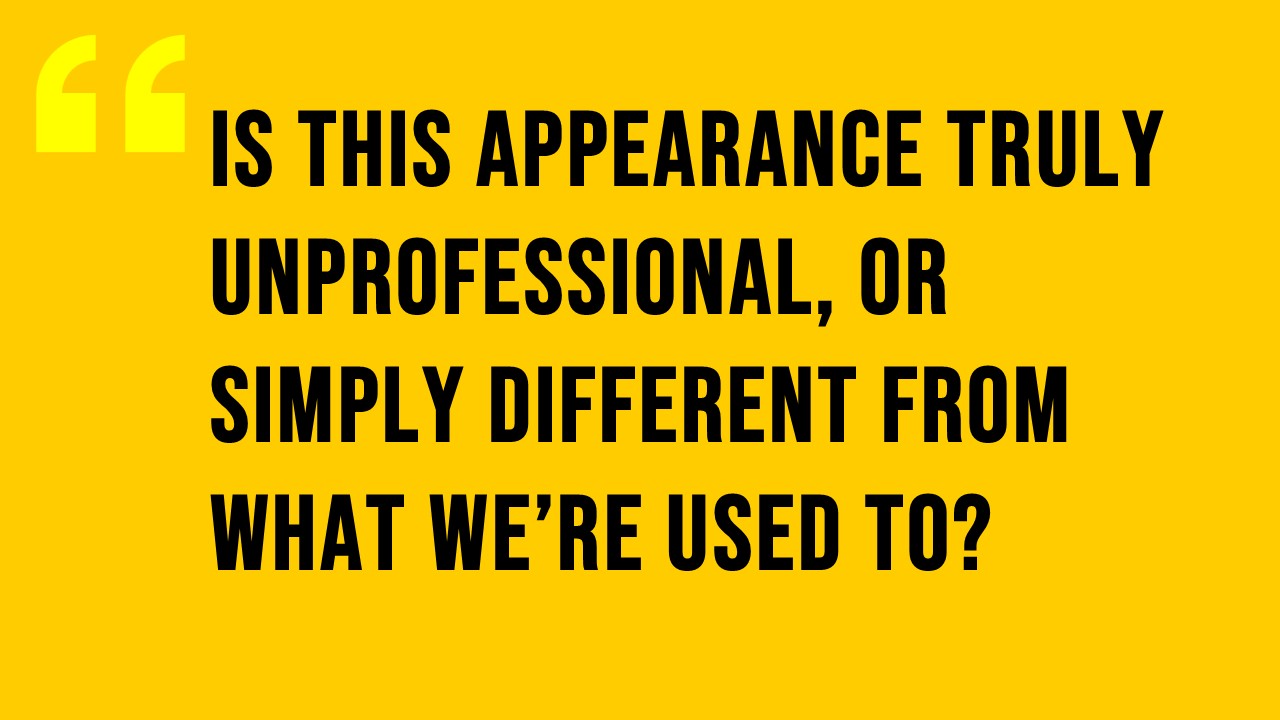
Another powerful question we can use is: “Is this behavior or appearance unprofessional, or just different from what we’re used to?” This question helps us distinguish between actual professional standards and our personal preferences or cultural biases.
A friend of mine working for a major European airline shared a conversation she had with a peer about whether to hire a candidate. Her peer was disturbed by the candidate’s Afro hairstyle, which he considered unprofessional. Using this questioning technique, they could see that the hairstyle was certainly different from what he was used to, but it had no correlation with the person’s ability to do the job.
This distinction between “unprofessional” and “different” is crucial for inclusive leaders. We must constantly examine whether our standards are truly about professional competence or simply about conformity to our own expectations and experiences.
Using Counter-Stereotypical Examples
Another powerful way to challenge biases is to find counter-stereotypical examples and positive role models. When we encounter bias-based objections, we can often interrupt them by providing concrete examples that contradict the underlying stereotypes.
I was once in a talent review meeting where a man was being considered “too young” for a promotion. One of the participants came up with several examples of people of the same age who had been promoted to similar roles and were performing well. Age then became a non-issue in the discussions.
This technique works because it moves us from abstract stereotypes to concrete examples. It’s harder to maintain biased assumptions when faced with evidence that contradicts them.
Uncovering Patterns Through Data Analysis
While questions and techniques help us interrupt bias in the moment, we also need to step back and look at patterns in our decision-making over time. Our biases often reveal themselves through consistent patterns that are invisible to us on a daily basis but become clear when we examine the data.
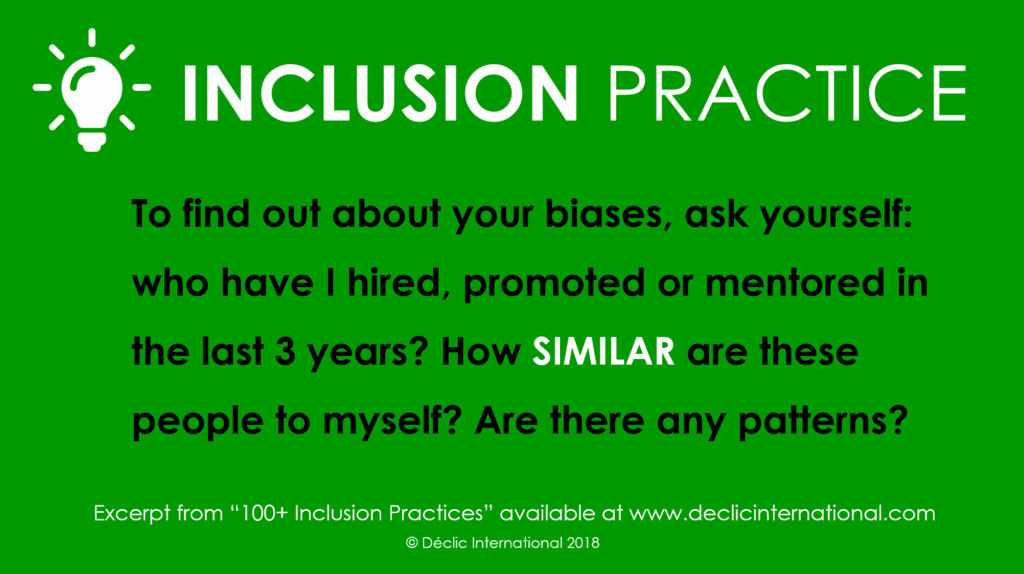
As inclusive leaders, we should regularly ask ourselves: In the previous years, who are the people we hired and promoted? Who are the people who got the most high-profile assignments? Who left our teams? Is there a pattern we can spot? Is there a similarity in the profiles?
We should look at our metrics at least once a year or during key moments such as before hiring, talent reviews, annual performance reviews, and calibration meetings. Basic metrics to examine include representation by gender, age, and ethnicity (or whatever diversity data is available) by level, in recruitment, promotion, attrition, performance, and engagement.
Looking for Proportionality and Gaps
When analyzing our data, we should look for proportionality. For instance, if men are thirty percent of our team, we’d expect them to be roughly thirty percent of promotions. If there’s a significant discrepancy, we need to investigate why.
We should also look for gaps. For example, if the engagement scores of people over fifty are much lower than those of other age groups, we should inquire about the reasons. If turnover rates of people from ethnic minorities are higher, we need to find out why.
One of my clients, an Italian food manufacturer, identified a clear disengagement gap among employees caring for others, both children and parents. This finding prompted the company to revamp its flexible working and family-friendly policies, leading to improved engagement and retention.
Making Bias Interruption a Daily Leadership Practice
The key to effective bias interruption is making it a regular part of our leadership practice. We can’t just use these techniques occasionally – we need to build them into our daily routines and decision-making processes.
This means asking “Where’s the potential bias in this situation?” in every people-related decision. It means using the “Flip it to test it” technique when we hear potentially biased comments. It means regularly reviewing our data to identify patterns and gaps.
Most importantly, it means creating psychologically safe environments where these conversations can happen openly and constructively. When we model this behavior as leaders, we give others permission to do the same.
The Ripple Effect of Bias Interruption
When we consistently practice bias interruption techniques, we create a ripple effect throughout our organizations. We model the kind of thoughtful, reflective leadership that others want to emulate. We create cultures where bias is discussed openly rather than hidden, where questions are welcomed rather than feared, and where data is used to drive more inclusive decisions.
This isn’t just about being better people – though that’s certainly part of it. It’s about being more effective leaders who make better decisions, build stronger teams, and create environments where everyone can contribute their best work.
The techniques I’ve shared aren’t theoretical – they’re practical tools that work in real-world leadership situations. They’ve been tested in boardrooms, performance reviews, and hiring meetings across industries and cultures. They work because they’re based on a simple principle: when we pause to question our assumptions and examine our patterns, we make better decisions.
As inclusive leaders, we have the power to interrupt bias – in ourselves and in our organizations. We have the tools to create more equitable, inclusive environments where everyone can thrive. The question isn’t whether we can do this work – it’s whether we will.
Thanks for reading. Please let me know your thoughts in the comments!
***
This piece is adapted from my upcoming book, Practising Inclusive Leadership.
Curious about my Inclusive Leadership Online Programme for HR professionals or my Inclusive Leadership Train-the-Trainer Retreat in Cyprus? Click HERE to register your interest and get all the details and early birds.